
Whitening results fade gradually, and how quickly varies from person to person. For the first 24 to 48 hours, the usual advice is to avoid strongly colored food and drink. After that, good daily habits, regular dental cleanings and an occasional top-up, planned with your dentist, help the result last longer.
The first two days: less color, more water
Right after whitening, teeth pick up color more easily than usual. That’s why the common advice for the first day or two is to stay away from food and drink that stain. Ask your dentist what applies in your case. Usually that means:
- Coffee and tea
- Red wine
- Cola and other dark soft drinks
- Dark sauces such as soy sauce, tomato sauce and balsamic vinegar
- Berries, beets, and strongly colored spices like turmeric
- Smoking and other tobacco
A simple rule of thumb: if it would stain a white shirt, save it for later. Water, light-colored foods and clear drinks are generally a safe choice for those first days. And once the two days are up, ease back into the colorful stuff rather than making up for everything you missed in a single day.
Questions after the session? Your dentist is there for you. For more on the session itself, see Whitening without pain or sensitivity: how OBIOWHITE is built for it.
Daily habits that slow the fade
Your new shade won’t look after itself, but you don’t need to overhaul your life either. A few simple habits do most of the work:
- Brush twice a day with a fluoride toothpaste, and clean between your teeth every day
- Rinse with water after coffee, tea or wine, or keep a glass of water alongside
- Use a straw for cold dark drinks like iced coffee or cola
- Cut back on or quit tobacco, which stains quickly
- Keep up regular checkups and professional cleanings, which remove surface stains before they build up
You don’t have to give up coffee. The goal is simply less color sitting on your teeth, for less time.
What about whitening toothpaste? It can help lift new surface stains, but it doesn’t replace a top-up and doesn’t change the tooth’s underlying shade. Ask your dentist which toothpaste suits you.
When and how to top up
As your shade slowly starts to slip back, a top-up can bring it forward again. There’s no fixed date that works for everyone; it depends on your teeth and your habits. The right timing is the one you and your dentist agree on.
To spot that moment, try taking a photo of your teeth in daylight right after whitening, then again every so often in the same spot and the same light. Side-by-side photos show a gradual change that’s hard to see in the mirror from one day to the next, and give you and your dentist something concrete to talk about.
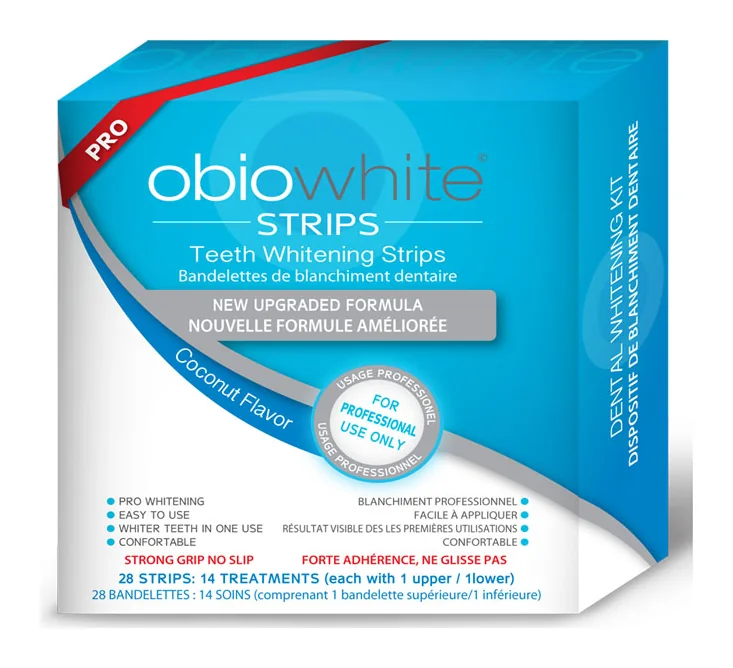
If you whitened in the clinic, strips your dentist gives you are a common way to top up. According to the manufacturer, a course of OBIOWHITE STRIPS is one treatment every other day for 7 treatments, 60 minutes each, and can be repeated after a month if needed. Your dentist’s instructions come before any general guidance. For how the two routes compare and work together, see In-clinic or at home.
More isn’t necessarily better. Whitening more often won’t keep making your teeth lighter, so use it only as your dentist instructs. A planned, measured top-up beats a rush toward a lighter shade.
If you have dental work coming up
New fillings, crowns and veneers are matched to the shade of the teeth around them. If you’ve whitened recently, tell your dentist before any work like that, so the new restoration matches your new shade rather than the old one, and ask when the right time is to do the matching.
The same logic works the other way around: if you already know a front tooth needs a restoration, talk to your dentist early about which should come first. That way you don’t end up with a new crown matched to a shade you no longer have.
What to expect over time
- The shade fades gradually, not all at once. How fast that happens varies from person to person, and there’s no single number that holds for everyone.
- Habits make a difference. Coffee, tea, wine and tobacco speed up the return of stains; a good brushing routine and regular cleanings slow it down.
- Restorations don’t change. Crowns, veneers and fillings stay the color they were made. If a front restoration stands out after whitening, bring it up with your dentist.
- Natural teeth still look natural. The aim is a lighter version of your own teeth, not a flat, uniform white.
If something surprises you along the way, like a stain that keeps coming back on one tooth or a tooth that turns darker, that’s a reason for an exam, not another round of whitening. For what whitening can and can’t change, read How professional whitening works.
What to ask your dentist
What should I avoid in the first days, and for how long? When am I likely to want a top-up, and with which product? Are there restorations that should be matched to my new shade? For how strips are used at home, see our at-home whitening page.