
Professional whitening uses a peroxide gel to break down the colored molecules that build up in and beneath the enamel, so the tooth looks lighter. It works on natural teeth only: crowns, fillings, veneers and bonding stay the color they were made. How much lighter your teeth get depends on what caused the discoloration in the first place, which is why a dental exam comes before any whitening.
What actually happens inside the tooth
Tooth color comes from two layers. Enamel, the hard outer layer, is slightly translucent. Underneath it is dentin, which is naturally more yellow and shows through. Over the years, pigments from food, drinks and tobacco work their way into the surface of the enamel and the tiny spaces within it, and the tooth reads darker. That mix of enamel thickness, natural dentin color and type of stain is also why results differ from one person to the next.
Whitening gels contain either hydrogen peroxide or carbamide peroxide, which breaks down into hydrogen peroxide. The peroxide moves into the enamel and dentin and breaks large pigment molecules into smaller ones that reflect less color. Nothing is painted onto the tooth and no layer is removed; the change happens inside the tooth itself.
That’s also what separates whitening from “whitening” toothpaste. Those toothpastes mostly polish away surface stains with mild abrasives. Your teeth can look cleaner, but their underlying shade doesn’t shift the way it does with a peroxide gel.
What makes whitening “professional”
Professional whitening is done by a dentist or under a dentist’s direction. In the clinic, the dentist protects your gums with a barrier, applies a more concentrated gel, and watches how your teeth respond throughout. A session usually takes about an hour; your dentist will tell you what to expect in your case. At home, professional products are given to you by the dentist, who decides whether they suit you and how you should use them.
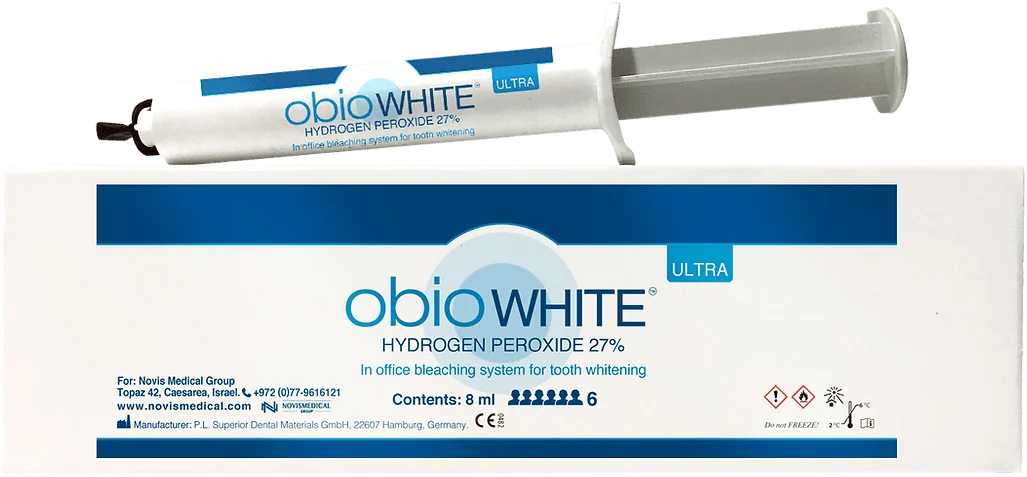
OBIOWHITE is a professional system of this kind. According to the manufacturer, the family includes an in-clinic whitening gel (OBIOWHITE ULTRA), an LED lamp used in the clinic, a gum-protection gel, a prep gel applied before whitening, and OBIOWHITE STRIPS for use at home under a dentist’s guidance. For how the two routes compare, see In-clinic or at home.
Not every stain responds the same way
Dentists usually sort discoloration into two broad kinds, and each responds to whitening differently:
- Surface stains come from coffee, tea, red wine, cola, tobacco and some foods. They sit on and in the outer enamel and generally respond well to whitening.
- Stains from within come from aging, as enamel thins and more dentin shows through; from certain medications taken while the teeth were still forming; from too much fluoride in childhood; or from an injury. These can respond more slowly, or less.
- A single tooth that’s darker than the rest is often a sign of something going on inside that tooth, such as an old injury or a past root canal. Whitening the whole smile won’t even it out, and it should be looked at on its own.
As a general rule, teeth with a yellowish tone tend to respond better than teeth with a grayish tone, and some stains lighten only partly. Your dentist can usually tell you ahead of time which kind you’re dealing with and what’s realistic.
What whitening doesn’t change
Peroxide works on natural tooth structure only. Materials made in a lab or shaped in the chair don’t respond to it, so these keep the color they were made:
- Crowns and bridges
- Veneers
- Tooth-colored fillings and bonding
- Dentures
This matters most when one of your front teeth has a restoration. After whitening, the natural teeth around it can end up lighter than the crown or filling, and the difference may stand out more than it did before. If you’re planning new work on your front teeth, it’s common to whiten first and match the new restorations to the new shade. Your dentist will tell you the right order and timing for your mouth.
Whitening doesn’t treat anything, either. It won’t fix cavities, gum disease, cracks or worn enamel, and it doesn’t change the shape or position of your teeth. It changes shade, and that’s all.
Why the exam comes first
Whitening gel should go on healthy teeth and gums. Before whitening, your dentist will typically look at:
- Untreated cavities, and older fillings that may no longer seal well
- The health of your gums, and any exposed roots
- Existing restorations, and how they’ll look next to lighter teeth
- The likely cause of the discoloration, and whether whitening is the right tool for it
- Any sensitivity you already have, and how your teeth reacted to whitening before
Sometimes the answer is to treat something else first, or a professional cleaning on its own takes care of much of the surface staining. Sometimes whitening turns out not to be the right fit, and another option will serve you better. Either way, you start out knowing what result is realistic. And if you’d like to know what the session feels like, read how OBIOWHITE is built to be free of pain and sensitivity.
What to ask your dentist
Is my discoloration on the surface or from within? Which of my teeth have restorations that won’t change color? What shade change is realistic for me, and does anything need treating first? To see what a session involves, read about in-clinic whitening.