
The right time to whiten is after orthodontic treatment ends: once the brackets or the aligner attachments are off, your teeth have been cleaned and polished, and your dentist has checked them. Whitening gel works only on the tooth surface it touches, so anything still bonded to a tooth leaves a patch that doesn’t lighten. Planning it with your orthodontist and your dentist keeps the shade even.
Why the shade can come out uneven
With traditional braces, a small bracket is bonded to the front of each tooth. Clear aligners often use attachments: small tooth-colored bumps bonded to some teeth so the aligner has something to grip. Either way, part of the tooth surface is covered. Whitening gel works where it touches natural tooth, so the area under a bracket or attachment stays at its old shade while the tooth around it gets lighter. When the bracket or attachment comes off, its outline can show.
Attachments are made of tooth-colored composite, the same family of materials as white fillings, and composite doesn’t change color with whitening. That’s general dental knowledge, true of every whitening system rather than any one product. For more on what whitening does and doesn’t change, read How professional whitening works.
There’s a practical side, too. During treatment, plaque builds up easily around brackets and attachments, and teeth are harder to clean well. Whitening is meant for clean, healthy teeth, so its natural place is at the end. Your dentist also wants to see your teeth with nothing bonded to them, to examine them properly before deciding on whitening.
What happens when the braces or attachments come off
At the end of treatment, your orthodontist removes the brackets or attachments and cleans off the leftover bonding material. This is when many people notice their teeth look different than they remember: a little duller, or with areas that were hidden under the brackets. Some see small white, chalky marks where plaque sat around a bracket. All of these are worth showing your dentist before you whiten. They’re part of the exam, and your dentist will tell you what whitening can and can’t do about them.
How long should you wait between getting your braces off and whitening? That’s a question for your orthodontist and your dentist. There’s no single answer that fits everyone, and they know what your teeth have been through.
What if the big day comes before treatment ends?
Sometimes a wedding, a photo shoot or a family event falls in the middle of treatment, and wanting to whiten now makes sense. Before you do anything on your own, talk it over with your orthodontist and your dentist. They can tell you what’s possible at your stage and what’s better left for later. Ask, too, whether a professional cleaning makes sense now; the whitening itself usually waits for the end. For a calm timeline, see Whitening before a wedding, an event or a photo shoot.
Retainers and whitening
Almost everyone gets a retainer after orthodontic treatment, and it shapes the plan:
- A fixed retainer, a thin wire bonded behind your front teeth: tell your dentist about it. It’s part of the plan, like anything else bonded to your teeth.
- A removable clear retainer is there to hold your teeth in place. Don’t use it as a whitening tray unless your dentist specifically tells you to. That’s not what it was made for.
- Your wearing schedule: ask how whitening fits around the hours you wear your retainer, especially if you’re planning to use strips at home.
How to plan it with your dentist
A simple order of steps that helps the shade come out even:
- Finish orthodontic treatment, including removing the brackets or attachments and polishing the teeth.
- Book an exam and cleaning with your dentist, who checks your teeth, your gums, any white marks and existing restorations.
- Have your current shade checked against a shade guide before anything starts, so you can see the change later.
- Whiten: in the clinic, at home with strips your dentist gives you, or both. The differences are in In-clinic or at home.
- If tooth-colored bonding or fillings on your front teeth need redoing, that usually happens after whitening, so they can be matched to your new shade.
- Keep the result with good habits and, if your dentist suggests it, strips for upkeep. See Keeping your whitening result.
Whitening with OBIOWHITE after orthodontics
OBIOWHITE whitening is free of pain and sensitivity. In the clinic, your dentist preps your teeth with OBIOACTIVE, protects your gums with OBIOGINGIVAL, applies OBIOWHITE ULTRA and uses OBIOWHITE LAMP, which, according to the manufacturer, gives off no heat, UV or infrared. The details are on the in-clinic whitening page.
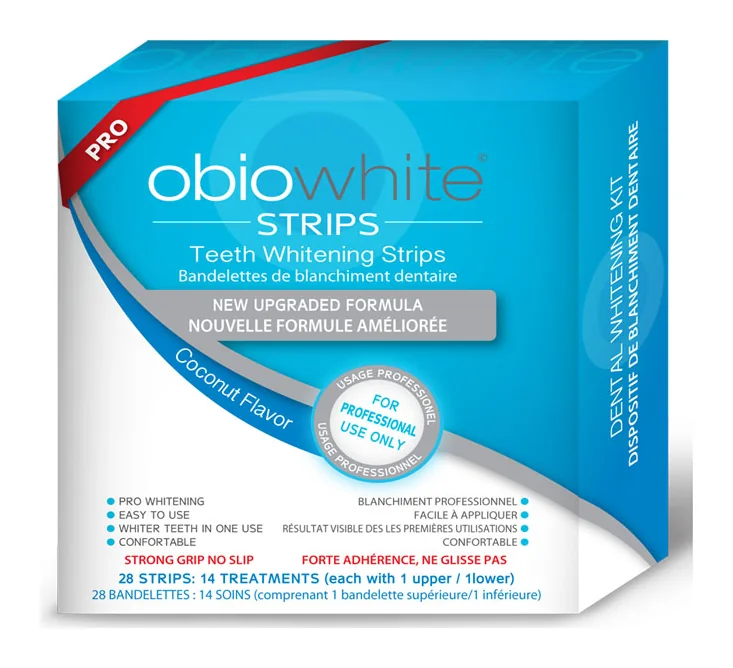
For home, OBIOWHITE STRIPS come through your dentist: the box says they’re for professional use only. If your teeth felt sensitive after your braces came off, mention it at the exam. It’s information your dentist uses in planning. More in Whitening without pain or sensitivity.
What to ask your dentist
Is anything left on my teeth from the brackets or attachments? What will whitening do about the white marks I can see? How long should I wait after the braces come off? I have a fixed retainer; does that change anything? Should my bonding be redone after whitening? More answers in our FAQ, or leave your details to ask about suitability.