
In-clinic whitening uses a stronger gel applied by your dentist and usually gives a faster, more noticeable change in a single visit. Whitening at home, with products your dentist gives you, works more gradually and is well suited to continuing or maintaining a result. That’s why many people combine the two: a session in the clinic, then strips from the dentist to take home and carry it forward.
In the clinic: faster, and fully in the dentist’s hands
During an in-clinic session, your dentist protects your gums with a barrier gel, applies a concentrated whitening gel, and keeps an eye on how your teeth respond the whole time. Some systems also use a light during the session. A session usually takes about an hour; your dentist will tell you what to expect.
With OBIOWHITE, the in-clinic gel is OBIOWHITE ULTRA, which contains 27% hydrogen peroxide according to its label. The manufacturer also makes a gum-protection gel (OBIOGINGIVAL), a prep gel applied before whitening (OBIOACTIVE), and the OBIOWHITE LAMP, which according to the manufacturer combines blue and red LED light and gives off no heat, UV or infrared. There’s more on our in-clinic whitening page.
The clinic route makes sense when you want a visible change in a short time, ahead of an event, say, or when you’d rather have a professional handle every step.
At home: gradual, and on your own schedule
Home whitening uses a lower concentration over a series of treatments. The change builds more slowly, and you do it at home, at times that work for you. It fits when you’re not in a hurry, when it’s easy to build into your routine, or when you’ve already whitened in the clinic and want to carry on from there. It does take consistency: the result builds from one treatment to the next, so finish the course the way your dentist set it out.
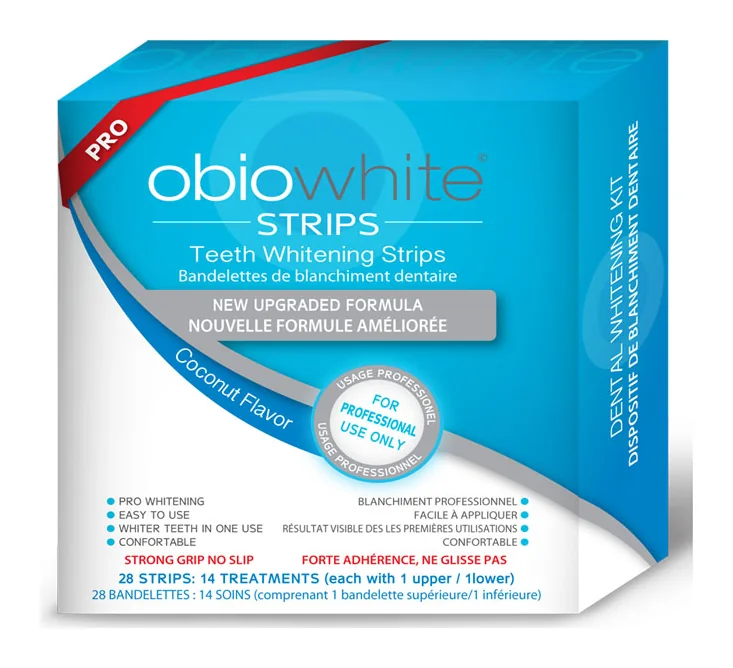
Not every home product is the same. One you get from your dentist comes with an exam behind it and someone to call if something doesn’t feel right. OBIOWHITE STRIPS are labeled for professional use only, so they’re given out by the dentist. According to the label, they contain 6% hydrogen peroxide, and a box holds 28 strips, or 14 treatments, each with one strip for the upper teeth and one for the lower.
According to the manufacturer, a course is one treatment every other day for 7 treatments, with each strip worn for 60 minutes, and it can be repeated after a month if needed. The longer strip goes on the upper teeth and the shorter one on the lower. Follow your own dentist’s instructions; they come before the general ones.
What about products you buy on your own?
Some whitening products are sold without a dentist involved at all. The main difference isn’t only what’s in the box, but what happens before and after. Without an exam, you might whiten over a cavity nobody has found, discover only at the end that a front restoration hasn’t changed color, or have no one to ask when something doesn’t feel right. If you’re considering one, check with your dentist before you start.
The two side by side
| In the clinic | At home with strips | |
| Who applies it | Your dentist | You, after your dentist gives you the strips and explains how to use them |
| Strength (per the label) | OBIOWHITE ULTRA: 27% hydrogen peroxide | OBIOWHITE STRIPS: 6% hydrogen peroxide |
| Time | A session usually takes about an hour | Per the manufacturer: 60 minutes, every other day, 7 treatments |
| Pace of change | Faster, within one visit | Gradual, over the course |
| Gum protection | A barrier applied by the dentist | Strips placed along the gumline as instructed |
| Sensitivity | None — free of pain and sensitivity | None — free of pain and sensitivity |
| Best suited to | A clear change in a short time | Continuing, maintaining, or a gradual change |
Why many people do both
Each route does a different job. The clinic session makes the main change, under your dentist’s control. Home strips then continue it, or help you hold on to it as the shade gradually fades over time. It also makes planning easier: you know what happens in the clinic, what continues at home, and when to check back with your dentist.
According to the manufacturer, OBIOWHITE STRIPS were designed for exactly that: maintaining and building on a professional in-clinic whitening over time. In practice, it’s a pairing many clinics offer: a session in the chair, then strips to take home, used as the dentist directs.
Some people start at home and never need more. Others prefer one clinic visit and leave it there. There’s no single right answer. The right route is the one that fits your teeth, your schedule and the result you’re after.
Questions that help you decide
- How soon do you want to see a change?
- Are your teeth already sensitive? If so, talk it through with your dentist before choosing. See also Whitening without pain or sensitivity: how OBIOWHITE is built for it.
- Do you have crowns, veneers or fillings on your front teeth? They won’t change color either way.
- Will you keep up with a series of treatments at home?
- Does keeping the result over time matter to you? If it does, plan for maintenance from the start.
What to ask your dentist
Which route suits my teeth, and why? If I start in the clinic, should I continue with strips at home, and when? How will I know it’s time for another course? For how the strips are used at home, see our at-home whitening page.