
Yes, you can whiten your teeth at 40, 50, 60 and beyond. Age alone doesn’t decide it; the condition of your teeth and gums does. Teeth look darker over the years for a few reasons: enamel wears and thins, so more of the yellower dentin underneath shows through, and decades of coffee, tea and wine leave stain behind. Professional whitening handles that stain well. What it doesn’t change are fillings, crowns and veneers, or roots exposed by receding gums. That’s why you start with an exam, where your dentist sees which of these apply to you.
At 45 or 60, you want to look like yourself at your best, not like someone else. The good news is that much of what makes teeth look “older” is exactly what whitening is good at. The rest mostly takes some smart planning.
Why teeth look darker over the years
It isn’t a sign that something is wrong. It’s how teeth age, and it happens in several ways at once:
- Enamel thins. Years of chewing, brushing and acidic food wear down the tooth’s outer layer. Enamel is partly translucent, so as it gets thinner, the yellowish color of the dentin beneath it stands out more.
- Stain builds up. Every cup of coffee, tea or glass of wine, and tobacco for anyone who smoked, leaves a little color on the tooth and in its outer layer. Over decades, that adds up to a shade you can see.
- Restorations stay behind. Fillings, crowns and veneers placed ten or twenty years ago were matched to your teeth as they were then. Your teeth changed around them; the restorations kept their color.
- Gums recede. When gums pull back a little, part of the root is exposed. The root is darker than the crown of the tooth, so teeth can look longer and darker near the gum line.
What professional whitening can do
The stain that has built up over the years is extrinsic stain, and it’s the kind professional whitening handles best. The whitening gel breaks down color molecules in the enamel and just beneath it, and yellowish teeth usually respond better than grayish ones. How much lighter your teeth get depends on your starting shade, what’s causing it and the tooth itself. Your dentist can usually tell you at the exam what’s realistic.
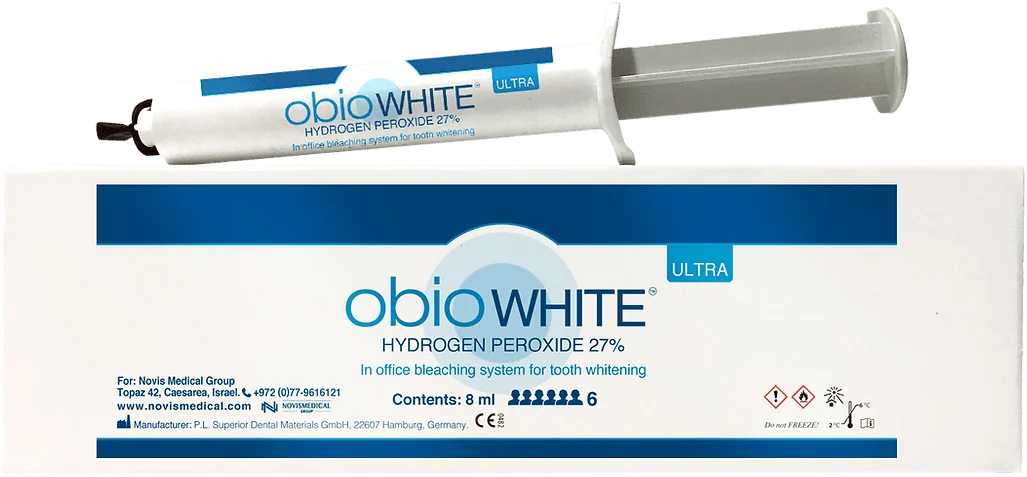
OBIOWHITE whitening is free of pain and sensitivity. In the clinic, your dentist preps your teeth with OBIOACTIVE, which contains potassium nitrate according to the manufacturer, protects your gums with OBIOGINGIVAL and applies OBIOWHITE ULTRA, which per the label contains 27% hydrogen peroxide. The details are on the in-clinic whitening page.
And what it can’t do
- It doesn’t change crowns, veneers, fillings or bonding. They stay the color they were made.
- It doesn’t lighten exposed roots. The part uncovered by receding gums keeps its own shade.
- It doesn’t restore worn enamel. It changes color, not the structure of the tooth.
- It doesn’t treat gums or decay. Those are treated first, and whitening comes after.
The exam first: it matters even more with time
The more years go by, the more history your mouth has: more restorations, maybe some gum recession, maybe small cracks. Your dentist checks for decay, including around old fillings and on exposed roots, and looks at your gums, any cracks, and any sensitivity your teeth already have. If you have exposed roots, mention whether they feel sensitive today. That’s part of making sure whitening fits you, and of planning it. Your dentist will often suggest a professional cleaning first, so whitening starts on clean teeth. Before you leave, ask to have your shade checked against a shade guide, so you’ll be able to see the change. For what that visit looks like, see Your first whitening visit.
Restorations: whiten first, then match
This is the part most worth planning ahead. If you have a crown or veneer on a front tooth, it may look darker than its neighbors after whitening, because they got lighter and it didn’t. If you’re planning new work on your front teeth, the usual order is to whiten first, then match the new work to your new shade. Sometimes, after whitening, your dentist may suggest replacing an older restoration so it matches. Better to talk all of this through before treatment than to discover it in the mirror afterward. For more on what whitening does and doesn’t change, see How professional whitening works.
A slightly different question for each decade
- In your 40s: How much of my shade is coffee and tea stain, and how much is the color of the tooth itself? Are there old fillings on my front teeth that will stand out after whitening?
- In your 50s: Do I have any gum recession, and where? Which restorations should stay as they are, and which should be matched after whitening?
- At 60 and beyond: How do we fit whitening around the dental work I already have, and in what order? What’s a realistic goal in my case?
At any age, the goal is a shade that suits your face: lighter and more even, but natural. Chasing the teeth you had at twenty often looks less natural than a bright shade that fits you now.
Keeping the result
For the first 24 to 48 hours after whitening, the usual advice is to avoid strongly colored food and drinks. After that, the same habits that protect your enamel help your shade too: a soft brush and gentle brushing, cleaning between your teeth, water alongside your coffee, and regular cleanings with your dentist. When the shade starts to drift, you can touch it up with your dentist’s guidance, for example with OBIOWHITE STRIPS at home. See At-home whitening and upkeep and Coffee, tea and wine after whitening.
What to ask your dentist
What’s behind the shade of my teeth: stain, thinner enamel, restorations or exposed roots? What’s realistic for me? Which of my restorations will stand out after whitening, and what’s the right order if I’m planning new work? Do I need a cleaning or any treatment first? Terms like enamel, dentin and shade guide are explained in our glossary, and there are more answers in our FAQ.